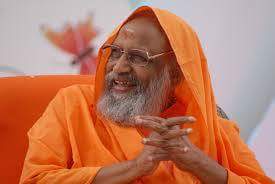
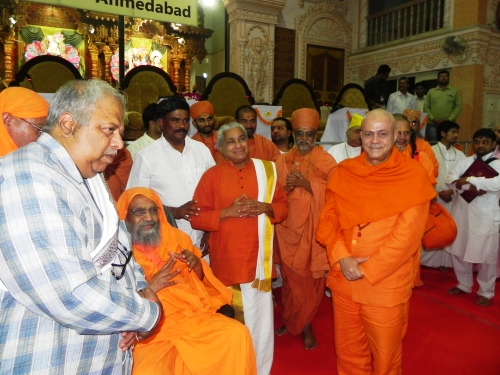
I have put in my Google Drive and am giving you all the link until such time as I have time to compose it on Blogger again. Please try the link below
Sunday, October 25, 2015
Thursday, October 1, 2015
Dr Anantanand Rambachan on Pujya Swami Dayananda
Few teachers have fulfilled their obligations to their tradition as Swami Dayananda Saraswati did. He has left our world richer with teachers.
In 1973, after graduating from the University of the West Indies, I made a long journey from my home in Trinidad to study at the Sandeepany Sadhanalaya, the aśrama in Mumbai, India, founded by Swami Chinmayananda (1916-1993). This was my first visit to India, the birthplace of my Hindu ancestors. It was a time when few from my country traveled to India.
I was a teenager when Swami Chinmayananda first visited Trinidad in 1965 and I avidly read his available writings. In 1969, I wrote to him for permission to join his aśrama. His sage advice, after rebuking me for my undated letter, was to complete my college education before coming to Sandeepany. In 1973, Sandeepany Sadhanalaya launched its first intensive multi-year course of study in Vedānta and Sanskrit. By then, I had fulfilled Swamiji’s advice and I was accepted as his student.
Mumbai was drenched in monsoon rains when I made my way from the airport to Sandeepany. I was introduced to Swami Dayananda Saraswati, who I learned was the prinicipal ācārya and the designer of the course of study that I came to pursue.
When I arrived at Sandeepany, I discovered that the course had already started. Swamiji, in fact, had completed his teaching of one of the foundational texts, Śaṅkara’s Tattvabodha. Tattvabodha offers concise definitions of the major terms and concepts of Vedānta and is a necessary preliminary to further study. Realizing that I would be at a learning disadvantage for his Upaniṣad classes, Swamiji offered to teach the text again and did so in intimate sessions in his kutir. Though he had recently completed the text, his instruction was patient and thorough. These were features of his teaching that never wavered. There were never signs of impatience or haste.
This was my first and indelible experience of the one who would become the most influential teacher in my life. For the next three years, with rare breaks, I sat at his feet studying the Upaniṣads and the Bhagavadgītā with the commentaries of Śaṅkara.
When Swamiji was ready to begin the teaching of the Bhagavadgītā, he wanted a location where the ancient ṛṣis themselves taught and where their memories were still alive. He took us all to Purana Jhadi in Rishikesh. There was no accommodation at Purana Jhadi. Swamiji had a tiny one-room cottage, and so we stayed in the spartan rooms of Andhra Ashram. On early mornings and late afternoons, we sat in the open on the banks of the Ganga, breathing the cool air and listening to his meticulous verse by verse exposition of the Bhagagavadgītā. The Ganga roared unceasingly in the background and Swamiji often spoke of it as symbolizing thesampradāya or flow of knowledge. Swamiji delighted in the simple and unencumbered ascetic setting of Purana Jhadi . It seemed a perfect setting, singing Ganga and silent Himalaya, for Swamiji to do what he loved beyond all else – teach. It does not surprise that Swamiji chose Rishikesh, a sacred space where he lived as both student and teacher, to be the site of his mahāsamādhi.
Swami Dayananda Saraswati was an abundantly gifted human being and these gifts found fruitful expression in a variety of achievements and initiatives. A proper and detailed assessment of his legacy is a necessary task for scholars of religion in the future. For his students across the world, however, the heart of this legacy is not in dispute. They have discovered it in his extraordinary gifts as a teacher of Vedānta; this is the image that is lovingly and gratefully alive in their hearts.
At the heart of Swamiji’s passion and creativity as a teacher was his foundational commitment to the Veda (śruti) as a source of valid knowledge (pramāṇa). The understanding of the Veda as a pramāṇa, though central to the methodology of the classical teacher, Śaṅkara, did not come easy to Swamiji. He spoke often to us of his early challenges as a student of Vedānta before he understood the Veda as a pramāṇa. His students, he would say, “do not know the magnitude of the discovery that the Veda is a pramāṇa. They did not suffer as I did.” He attributed his transformative understanding to the teaching of a Telugu-speakingsaṃnyāsin, Swami Pranavananda. Through the teaching of Swami Pranavananda, Swamiji came to see Vedānta as a direct means of knowledge for knowing the truth of oneself, even as the eyes serve as the instrument for the knowledge of forms and colors. “That was enough for me,” said Swamiji. “I never looked back. I had already studied theUpaniṣads – Vedāntaḥ. So, what was needed was only to rearrange – to look at the Upaniṣads, the whole teaching in the light of Pramāṇam.”
Any description of Swamiji’s skillful teaching is incomplete without grasping this fact. This is where he always started his unfolding of the Vedānta vision. The human problem, as Swamiji tirelessly taught, is one of incorrect understanding of the nature of oneself that is full and whole, but erroneously taken to be incomplete and lacking. Ignorance is dispelled only by knowledge and knowledge must be derived from a valid source.
The Veda-pramāṇa consists of words. The potential of these words to dispel ignorance depends on their handling by a skillful teacher. Swamiji brought to his teaching a deep understanding of the possibilities and limits of language. He exercised meticulous care in his choice of words and used these with marvelous dexterity and deftness to instruct about that, “from whom all words, along with the mind, turn back having failed to grasp.” (Taittirīya Upaniṣad). He knew well the dangers of linguistic indiscipline and imprecision in speaking of brahman and sought always to use words with caution, and consistency. He was fresh and chaste in his teaching. Words can liberate and words can imprison; he tapped deftly into the liberating potential of the words of the Upaniṣads and taught his students to do the same.
As a teacher, Swamiji’s attention was unwaveringly centered on the end-purpose of his teaching- the freedom of the student sitting at his feet. He made mokṣa, an end that is too-often clothed in mystery and made to seem remote and difficult, real and accessible. He universalized the human problem as a sense of inadequacy and incompleteness, making it one that is validated in the experience of every human being. He presented mokṣa as freedom from self-inadequacy that is attained through understanding a teaching that dispels ignorance. He enabled us to see that the full being we want to become is immediately and always available. The presentation of the human problem and its resolution in these terms means that the Vedānta pramāṇa deals with a recognizable human issue. As a teacher, Swamiji clearly wanted to present the Vedānta pramāṇa in a manner that overcomes cultural or religious alienation and to make it accessible and relevant to a recognizable problem. I recall that in every class, at some point or the other, he imparted the vision of Vedānta in its entirety. To transmit the vision of the whole in this manner is no small accomplishment for a teacher, and Swamiji always did it with an irresistible relevance, charm and intimacy.
One of the eloquent statements about Swamiji’s impact and effectiveness as a teacher is his ability to nurture and produce capable teachers. He understood himself as belonging to an ancient lineage (sampradāya) of teachers and students. This lineage had both a teaching to transmit as well as a distinctive methodology to ensure proper transmission and continuity. He fulfilled his indebtedness to this tradition through his own earnest study, his commitment to teaching, and his founding of the Arsha Vidya Gurukulam as a place of teaching and learning. Few teachers have fulfilled their obligations to their tradition as Swamiji did. He has left our world richer with teachers, monastic and lay, who will contribute to the vitality of this tradition and produce new teachers.
Swamiji’s teaching was essentially an invitation to inquire. One cannot prove that the Vedānta, as a valid source of knowledge, works unless one is willing to give it a try by exposing oneself to a qualified teacher. As a teacher, he never demanded that his students assent to anything apriori. All he asked for was a willingness to try the teaching with an open mind. One must be willing to suspend judgments about the pramāṇa until it is given an opportunity to prove itself.
When I visited Swamiji for the last time in December 2014, forty-one years after we first met, his health was failing and he was frail in body. Each evening, however, a few of us sat around him in the lecture hall to listen to the transcript of his lectures on Taittīriya Upaniṣad. Between periods of listening, we would support him to exercise by walking around the room. He was attentive to each word, occasionally correcting the transcript, ensuring that his meaning was accurately communicated. His eyes and face lit up whenever a passage from the commentary of Śaṅkara was cited. He delighted in the clarity and logic of the argument. Commitment to the Veda-pramāṇa was the beginning and end of his self-understanding as a teacher.
One night, at the end of the session, he turned to me and spoke words that I will never forget, “Śastra pramāṇa does work.”
Jaya Gurudeva
Shri Kalyan Vishwanath Writes About Pujya Swamiji
Kalyan Viswanathan, President, Sanatana Dharma Foundation
Executive Vice President, Dharma Civilization Foundation
In the passing away of Pujya Swami Dayananda Saraswati, the divine has given up one of its most excellent forms of its myriad manifestations – the form and spirit of an extraordinary Guru. On a Gurupurnima day in a year past, Swamiji made the following observation – “There is no Guru without a Sishya”. In other words, the Guru and Sishya arise together, in relationship with each other. The readiness of the student, and the willingness of the Guru, is what makes the relationship flower. In Pujya Swamiji’s own words, the Guru is one who brings light into an area of darkness in the Sishya’s life. In the presence of a Guru, a Teacher, what was previously vague and unclear to the student, lights up with a brilliant clarity. Bharat has been blessed with many Gurus from many different Sampradayas, throughout its ages. And each Guru has addressed himself or herself to the needs of the people of their own time and age. In this lineage, some Gurus stand out, for their brilliance and eloquence, and Pujya Swamiji will be remembered as one of the finest among the Gurus of the various paramparas of Sanatana Dharma.
I began my association with Pujya Swami Dayananda Saraswati in the year 1994 in earnest, when I attended a series of his lectures titled – “Relationships and Freedom”, in Mumbai. At a time when I was a graduate student at Ohio State University, and dealing with existential questions about my own life – such as “Who am I?”; “What is my life for?”; “What is the purpose of this existence?”; and so on – I encountered Pujya Swamiji, and have maintained a close association with him, for over 21 years now. Every encounter with him, whether it was for a short period of time, under an hour, or for a protracted period of time, over several days or weeks, has been a meeting of transformational significance. What made this possible?
Swami Dayananda Saraswati’s unique gift lay in his constant seeking of how to communicate truths known to ancient Rishis to modern minds, pre-occupied with modern complexes and challenges. And perhaps even more importantly, his greatest gift was in his ability to speak to each person, in a manner that was most relevant and appropriate to that individual that addressed his or her most pressing spiritual need of the moment. At least, he seemed to speak to me, personally, whether he was addressing a whole audience, or just me in a private room, where there was no one else but just the two of us.
I arrived at the Ashram, in Saylorsburg, in 1994, somewhat bewildered by Hinduism, its seeming incoherence, and its seemingly myriad and often conflicting expressions, and its relevance to the questions that were engaging my mind at the time. It was a time in my life, that science and engineering held primacy of place, and everything had to be scientifically and logically explained and better still, empirically verified through experimentation and demonstration. For over a year, I challenged him, intellectually, rationally and scientifically. I was not prepared to accept him as a Guru, unless he met my own internal standard of acceptability, even though I myself was not clear what that “test” was. I was mostly skeptical; not willing to believe; not willing to accept anything at face value; I was irreverent; I was not filled with a manifest Shraddha in the traditional manner appropriate to a young Brahmin man; I was not even sure what it meant to be a Brahmin in today’s age and time. I had a deep disillusionment with the whole domain of Ritual and its pomp and circumstance - It lacked meaning and significance for me.
I had already deeply studied J. Krishnamurti, (1895-1986) whose austere life had held a special place in my heart. J. Krishnamurti’s singular and dramatic rejection of all tradition and Sampradaya, also held a tremendous value for me. I found Krishnamurti addressing himself to the moment, in current time. He seemed fresh every moment at every occasion – and nothing of the past seemed to cling to him. He seemed to be speaking from his own enlightenment, not from the authority of a scripture that codified someone else’s enlightenment. He was almost constantly mocking the lack of value of someone else’s enlightenment to one’s own life and its challenges.
The private dialog that I began with Pujya Swamiji, first took the shape of interrogating J. Krishnamurti, and to my tremendous surprise, I discovered that Swamiji himself had been a great admirer of J. Krishnamurti in his younger years. One would not discover this easily, because Swamiji has spoken very little of J. Krishnamurti publicly. I would take passages from Krishnamurti’s speeches into his room, where he and I would privately engage with that passage for 30 to 40 minutes even as a crowd of people gathered outside his room, patiently waiting for his Darshan. We spoke about Krishnamurti, Ramana Maharishi, Swami Vivekananda, Ramakrishna Paramahamsa and Mahatma Gandhi, and Swamiji would patiently answer my questions and engage with me, as though it was the most important thing to do at the moment. This kind of accessibility and relationship with a teacher had never existed for me, until this moment. Even as we were dealing with abstract ideas, a personal relationship was also taking shape.
The Shastra is a Pramana – A Shabda Pramana, and must be understood as that – he would say. I knew not what a Pramana was, let alone a Shabda Pramana. A Pramana is a means of knowledge; a means of communication – he would say, that allows a Guru to communicate to a Sishya. Without a Pramana, and the ability to utilize the Pramana, communication will always remain vague and unclear – he said; and we discussed the lack of a Pramana manifest in the life of teachings of J.Krishnamurti and Ramana Maharishi, and many others like them. I became intensely curious about what is a Pramana? Pramana is what makes a Parampara possible – he would say; it is the building block of reliable inter-generational transmission of the knowledge i.e. the Atma Jnana or the Brahma Jnana which was the subject matter of the Shruti. It is not a surprise that neither J. Krishnamurti nor Ramana Maharishi have a Parampara of any significance.
What is Jnana? Does knowledge not need the validation of personal experience? I would ask. In fact, it seemed to me, the personal experience of a J.Krishnamurti or a Swami Vivekananda, or a Ramana Maharishi, held a greater value for me at that moment, than the conceptual framework of Vedanta, once I began to grant the possibility that there was such a thing called “enlightenment”. So many times, we discussed the distinction between concept and experience, and how our experience validates our concepts, and how our concepts in turn give rise to our experiences. For those who have taken courses with Landmark Education, this is a central proposition in their programs – By simply transforming our concepts, we can bring into being entirely new experiences. However, Pujya Swamiji, insisted that our experiences can be deceptive. In fact, what we experience as solid, liquid and gaseous in the physical world, is nothing more than groupings of atoms and molecules, organized together in various densities – in fact the entire reality of this world as we experience it, is subject to re-interpretation. Even our physical bodies are mere assemblages of compounds and chemistry, subject to change and disintegration. What is real here? He would ask. Even the Sun only seems to rise in the east and set in the west. What is really going on is entirely different! I would come away from the conversation more bewildered about “Reality” – Satyam.
Little by little, he introduced me to the concept of “Mithya”, an order of reality that is intermediate between that which is wholly real (Satyam) and that which is wholly unreal (Asatyam); He gently questioned my attachment to scientific verification; Science concerns itself with objects that it can apprehend through the senses; Vedanta deals with the Subject who wields the senses and since the Subject cannot objectify itself – therefore the whole quest for scientific proof was illegitimate since it does not apply to the realm of the Subject; he would say. And I would come away reeling with a whole new dimension of inquiry. Vedanta and Science are orthogonal to each other – he said. The domain of Science is not the domain of Vedanta; (or the Veda); the domain of the Veda is nor accessible to Science; he would say. The people who are trying to demonstrate that the Veda is scientific, are missing the point – he would say. And I would walk away with a sense of awe about these conversations.
Vedanta was an investigation into the realm of Reality – Satyam. In that sense, its approach was more or less similar to the approach of a Scientist. However, the methods of science did not go far enough. As I listened to his discourses on “Reality”, different orders of Reality came into existence for me - the Ultimate Reality, the “Paramarthika” order; the seemingly Real i.e. the “Vyavaharika” order; and then there was also the imaginary reality – the “Pratibhasika” i.e. all that one imagines to be true, but is not really so. Science and the Scientific method was useful in distinguishing the Vyavaharika and the Pratibhasika orders – in fact much of the scientific critique of Hinduism as superstition arose from its commitment to empirical verification of propositions, which were largely confined to the Vyavaharika order of Reality. Science almost had no access to the realm of the Subject, the Spirit or Consciousness i.e. the Paramarthika order of reality. It could not comprehend it, measure it, and make observations about it. Science even today is unable to grapple with the phenomenon of consciousness, and assumes that it is merely a by-product of the physical body. If the Veda says something that is contradicted by scientific verification, then we must reject the Veda – Pujya Swamiji would say. That made sense. But on the other hand, if the Veda asserts something that cannot be disproved by Science, you must at least entertain the possibility of the Vedic propositions being valid – he would say. As this began to sink in, I gained a new measure of regard for the Veda, Vedanta and the Teaching tradition embodied in the Shruti, as it related to the domain of Science.
One day, he looked at me with great compassion, and said to me “I want to draw your horoscope and see what is in store for you”. I responded by saying “I don’t believe in horoscopes”. He asked me “Why not?” I said it is not reasonable to assume that the positions of planets and stars at the time of my birth somehow influence the trajectory of my life. It is in fact so absurdly unscientific that it seems to me only the extremely superstitious would believe in such things. He smiled at me, and said to me, “the planets and stars do not cause how your life turns out. But there seems to be a correlation between the positions of the stars and planets and the way a person’s life unfolds”. As I looked bewildered at him, he said “you know there is a difference between correlation and causality”. Even as I pondered that sentence, he said “These correlations are a matter of the Rishis’ knowledge – We may not understand it, but we must respect it – It is in fact Arsha Vidya – the knowledge of the Rishis”. That sentence rang in my ears for years to come. On the same day, in the classroom during Satsang, he proceeded to tell the story of how he himself at one time did not believe in horoscopes and how he came to believe in their power, through the predictions of a brother Swami who lived near Purani Jhadi in Rishikesh during his days of seclusion.
On another occasion, he said “Why don’t you start a Bhagavad Gita Class in Columbus, Ohio?” And I did. And this class went on for some six years or so. I went deep into the Bhagavad Gita, and began to enter into the mind of Adi Shankara. Since Adi Shankara wrote everything in Sanskrit, and we live in a time and age, where Sanskrit has largely gone out of fashion, Adi Shankara has become inaccessible to our current day humanity. The other Sampradayas, keep contending with Adi Shankara, without adequately either understanding or representing his positions and perspectives accurately. Through Swamiji’s words and teachings, I gained a new respect and regard for the brilliance of Adi Shankara.
On another day I asked him, what is the value of knowing something without being it? He replied that the word Jnana represents both knowing and being – it is in fact an ontological word. He proceeded to deliver a talk that day that the Teacher is the Teaching. Jnana fuses knowing and being together. The talk was so brilliant, that for the first time, I began to sense that Jnana is not knowledge, in the sense that we understand the word knowledge in English. There is more to that word. Sanskrit has many layers of meaning – often veiled by our own rendering of that word into English. He said that there are many lamps, and many flames – but there is only one Agni. Similarly, while there are many waves, puddles, lakes and rivers, there is only one water. Even as there are many electrical appliances such as a TV, Microwave, A light bulb, a fan and an air-conditioner, there is only one electricity that brings them all to life. Thus even as there are many bodies, the Atma is one. Thus your Atma and my Atma are non-different. And the Atma is untainted by the content of our minds and their afflictions, just as the Sky remains untainted by the clouds that gather within it. The Clouds and the Sky belong to different orders of Reality, just as the physical body and its shadow belong to different orders of Reality. One can enter into an argument with another man or woman, but not with their shadows. I would go home, with the words “different orders of Reality” ringing in my ears. Shravanam and then Mananam.
I had loved the ‘Being-ness” of J. Krishnamurti. He was a being with a great presence. But so was Pujya Swami Dayananda Saraswati. One abhorred the Shastra, and the other embraced it fully. And I began to see that the Shastra had nothing to do with it. But I also began to see, that without the Shastra, the medium of communication that generates clarity for the student, is somewhat impaired. But even if the Shastra provides the medium i.e. the pramana, the individual Guru also brings something to the Party. The extreme degree of fun and amusement that Pujya Swamiji could generate, even while unfolding the seemingly profound verses of the Upanishads, was extraordinary. I once took my father to a talk by Swamiji, and we laughed non-stop for ninety minutes. Pujya Swamiji was better than any stand-up comic that I have listened to – and far cleaner with his jokes. And boy, could he deliver a good story with a terrific punchline!
As our relationship evolved, I observed him launch a variety of new initiatives - the Aim for Seva movement, the Hindu Dharma Acharya Sabha; and many other projects. I saw his close involvement in the Rama Sethu Court Case; his angst at the condition of the Hindu temples in India; his involvement in ensuring that the seven hills of Tirumala remained with Tirumala; his engagement with the Saraswati River conference and so on. I started going to him with my own propositions. Shall I help you launch the Web Site for the Hindu Dharma Acharya Sabha? Of course, he said. And for a while, we managed that web site. I am going to launch an organization called Sanatana Dharma Foundation and a program called Vidya Daanam. Swamiji blessed it, and even gave a few words of blessing. One of the most remarkable aspects of our relationship is that Swamiji never imposed anything on me. He never asked me to do something, that he wanted me to do. In fact, it was almost always the other way around. I would ask him, “May I do this?” and he would readily bless the endeavor. In the Bhagavad Gita, Chapter 18, Verse 63, Bhagavan Krishna says to Arjuna – “yathecchasi tatha kuru”– Do as you please.This has been Pujya Swamiji’s governing philosophy. After all the teaching, after all the hours and hours of discourse, and questions and answers and Satsang – these have been his final counsel – “Do as you please”. I must regard this as his greatest gift to his students – he has never imposed his own choice or will on his numerous students, but rather allowed each one’s life to unfold and flower in its own unique way.
In the last two and a half years, I have been very involved with Dharma Civilization Foundation, Los Angeles, California, and the project that Pujya Swamiji initiated at the Graduate Theological Union, (GTU) Berkeley. I have discussed this initiative with him, on five different occasions in both Coimbatore and Saylorsburg, and on each occasion, he has grown more and more enthusiastic about this initiative. He has provided specific counsel, and very specific direction on how to move forward. His last wish to me was that we establish an “Adi Shankara Institute for the Study of Vedanta and Sanskrit” at the GTU, as an affiliate institution under the auspices of an independent, autonomous Graduate School of Hindu Dharma Studies which would function as the equivalent of a Hindu Seminary in the west. Evoking the same spirit with which Arjuna said “Karishye Vachanam Tava” i.e. “I shall act according to your word”, I too shall rededicate myself to the fulfillment of this vision, i.e. the creation of a Graduate School for Hindu Dharma Studies, and the Adi Shankara Institute within it. I can see no more fitting a tribute to the singularly committed life that Pujya Swami Dayananda Saraswati lived, than the dedication and devotion of our own energies to an initiative that he envisioned as worthy of our effort.
Tuesday, August 18, 2015
Ecology In The Bhagavad-Gita - Swami Dayananda
There are people who
are highly concerned that humanity is in danger. They warn that if conditions
continue like this, if people don’t care, the ozone hole will become so huge
that people will have a radiation problem. For some, the whole concern is for the
life of human beings and the suffering that they will have in the long run.
Therefore, they say that in order to protect human life, we have to protect the
environment, maintain the ecological balance—save the trees, save the
rainforest and create green lungs everywhere.
While we agree with this, the Gita has a wider
perspective that includes all forms of life. Why don’t all forms of life
deserve protection? Why only human life? What is distinct about human
beings and why do we place human worth above that of other creatures? What is
the sanctity of human life? In which way are the lives of other creatures on
this planet less sacred than human life?
In the third chapter of the Gita, we have:
devaan bhaavayataanena te devaah bhaavayantu vah
parasparam bhaavayantah shreyah paramavaapsyatha (BG
3.11)
Propitiate the deities with this (yajna). May those
deities propitiate you. Propitiating one another, you shall gain The highest
good (moksha). (BG 3.11)
The perspective offered by this
verse is not even limited to life on this earth—its scope is cosmic. The Gita
here is talking about an awareness of all the forces. In this vision, the
natural forces of the universe are not separate from Ishvara, the Lord, for the
universe is a manifestation of Ishvara, the Lord. We can look at this Lord from
the standpoint of a given force. As such, any phenomenon, any force, is
considered a devata, a deity. This entire jagat—the world of
names and forms, including natural forces—is a manifestation of the Lord. It is
not that Ishvara at a certain time created the jagat as separate from
himself. Although we may refer to the jagat as a ‘creation’ from the standpoint of the Lord as a conscious,
all-knowing being, this is not ‘creationism’. We may use the word ‘creation’, but
we follow it by the word ‘manifestation.’ Why?
In the view of creationism, the creator is
separate from his creation. Since the creator must have a place, where, then,
does he reside? If he is a distinct entity, where will he be? He would have to
be located in space. But space itself is a part of the whole space/time
creation. Where was the creator when he created space? The creator cannot be in
space and create space, for if he is in space, space has already been created.
If he is inside space, who created space? It is also not possible for him to be
outside space, spatially. The Lord cannot be an individual located outside
space, because which is the space that is outside space? Both ‘inside’ and
‘outside’ refer to space. The only real possibility is that space is not
separate from the Lord.
Only if we conceive of space/time as absolute
is the creationism model feasible. But modern physics, consistent with the
vision of Vedanta, has shown that space/time is not absolute. It has been
proven that space and time are collapsible and that they come to manifest along
with the other things. If that is so, space is more a manifestation of whatever
was the unmanifest cause. ‘Creation’ is the formful aspect of the
unmanifest—nothing new has been ‘created’. Space and time and everything in
space and time—the whole thing—is a manifestation of Ishvara. Therefore, space itself cannot be separate
from the Lord.
If that is so, then an awareness on the part
of human beings that they are not isolated entities and that the entire jagat is a manifestation of Ishvara, is in
order. With this awareness, we can strike harmony with the world; without or
against this awareness, we can constantly rub against our world. The truth of
rubbing is the one who rubs, who creates disharmony, gets rubbed. You cannot
rub against something without getting rubbed in the process. That is the truth.
And we are rubbed all the time, because we keep rubbing against the order of
things. We rub each other and we rub other life forms and matter. And then we
say that the world is inimical to us, and want to save ourselves from the
world.
Our foolishness is that we rub and then
complain that the world rubs us. “Why me?” is a common expression. “Why me?”
Everybody asks the same thing. Nobody is exempt from asking, “Why me?” “Why
me?” In everybody’s life, there are innumerable occasions to ask, “Why me?” In
the morning getting up you may ask, “Why me?” Although you may use different
words, the equivalent forms are constantly being murmured. This is due to not
being in harmony with what is. In order to be in harmony with the world, you
have to change the whole picture. You must have a bigger picture. Without
a bigger picture, small things become big things. With a bigger picture, small
things become smaller. The bigger the picture is, the smaller is your problem.
The big picture really resolves problems, and Vedanta gives you the biggest
picture possible. In this discussion, however, I am not talking of the biggest
picture—just a bigger picture. The amazing fact is that even the bigger picture
is enough to free you from a lot of rubbing.
The Gita says that your awareness
should not fall short of covering, of recognizing, Ishvara as the force because
of which all life forms and matter are possible. The reverence for forms is a
very, very important thing. Unfortunately, in many theologies, this reverence
has been destroyed. Some theologies prohibited worship of any form made of
hands or by nature, and located God somewhere far away from us. It was assumed
that by doing so, they were updating tribal religion. In fact, in the process,
theologies have lost their reverence for forms.
Such reverence, as expressed in the Gita and
other works, is an essential part of Hindu culture. When, as a child, I kicked
the ground, my mother would say, “Hey, don’t kick the ground. That is mother
earth.” “What mother earth? It’s dirt”, I said. “No! It’s mother earth, prithivi
maataa.” Then I would think, “Oh, this is mother, maataa.”
I come from an agricultural family. During a
particular month, the water would flow in the river and the agricultural
operation would begin. The first thing was to sow the seeds, the paddy seeds.
Then, after a few days or a month, they would remove the seedlings and
transplant them in the fields. This operation was done by all the villages.
Before sowing, although each villager would sow on his own piece of land, all
the villagers would come and do pujaa to a piece of land that belonged
to the temple. They would do pujaa to the earth. Seeing this as
children, we naturally developed a reverence for the earth. That shows a
concern not for my life alone—but for the one that bears the life. Mother earth
is not just something inert.
Inert is a point of view. For instance, when
you dream, you dream mountains and you dream mountain lions. In the dream, the
mountain lions are sentient and the mountains are inert. But you, the dreamer,
are not inert, and the dream universe is nothing but you. It is you who are the
dream characters and scenery. You are the creator and you are the manifestation
of the dream world. So when the dream character thinks that the dream mountain
is inert, it’s purely a point of view. You may say one—the dream mountain—is
insentient, and the other—the dream mountain lion—is sentient. But really, both
of them are not separate from you—the sentient you who is dreaming. It is the
same with Ishvara, the Lord. Everything we see in ‘creation’—other beings, as
well as what we consider ‘inert’ material—is not separate from the Lord. That
is why we don’t take mother earth for granted. The same is true for the other
natural elements. Water is called Varuna. The air that you breath in is Vaayu. Tvam
eva pratyaksham brahmaasi. “You alone are the perceptible Brahman.” In
fact, we don’t even need a form to evoke reverence. Vaayu, Air, is enough for
us. Space is enough. Time is also revered by us.
Time is generally the one that people are
afraid of, except when it is Fourth of July and you have a holiday. Otherwise,
time is the one that frightens everyone. That is because time levels everybody.
It is just with you, silent—a silent assassin. A silent destroyer, it changes
the hair of all—the black haired-one, the blonde-haired one—into what we call
gray. That, of course, is assuming that any hair is still there! Time is
ubiquitous. It doesn’t spare anybody or anything. Empires crumble in its wake.
But for Hindus, time is an object of worship. Is there another culture where
death itself can be considered God? Death is not an ordinary thing. Hindus
worship Mrityu—Dharmaraaja. So that we have no fear of death, we worship.
Suppose you see Mr. Death coming? You have to acknowledge him with reverence,
you do namaste. He may even spare you for some time, because he has to
reciprocate your namaste. Because death is considered a natural part of
the whole process, the fear of death goes away.
Similarly, every phenomenon, every force that
is here, from the standpoint of Ishvara, the Lord, is not inert because it is a
manifestation of that Lord. The awareness of forms being not separate from Ishvara
makes you aware of your environment cosmically. Our environment doesn’t stop
with the atmosphere. The ‘environment’ has an extending radius. To begin with,
the environment is your neighborhood. Then, extend that to the county, the
state, the country, the continent, the globe, the system, the galaxy and the
universe—that’s our environment. It is not an ordinary one, really. It’s
an amazing one, having so much to offer in terms of your own intellectual
adventure—so much to offer. We make inroads into Ishvara’s mind when we explore
and understand a particular subject matter. Therefore, we don’t consider any
knowledge to be secular. It is all Ishvara’s knowledge.
To be in harmony with the environment, the Gita
tells us to simply do what we have got to do every day, with a certain
awareness. Let all the devataas, the deities, do their jobs. Let the sun
shine. Let the air blow, and let it not get stuck in one place. Vaati iti vaayuh,
“Air is that which moves.” We need all the natural forces. Let every one of
them function. In fact, we don’t call them ‘forces’; we call them devataas,
because we are not referring to some merely material force. ‘Force’ is Ishvara,
the Lord, a singular noun that means all the forces together. All the forces
are one force. Otherwise, they would be in conflict with one another. They form
one singular force, which we call shakti. In Star Wars we heard, “May
the Force be with you.” May shakti be with you, the shakti of the
Lord. That’s the force.
If I am aware of the bigger picture, how can
I ever do anything inimical to this planet and to any life form that is here?
How can I eat an animal? It is very difficult. How can I harm anybody? How
can I harm anything—even the minerals? In other words, how can I abuse them? I
can use them, because we are all mutually dependent. I contribute, I consume. I
am not merely a consumer—I am a contributor, too.
Sometimes the contribution is to create what
I had to destroy. For instance, I am told in our Dharma Shaastra that if
you must cut a tree, then you should plant some also. It is not an easy thing
for a tree to grow to full height. It may take twenty years or thirty
years—then in a few moments it is cut down. The tree has survived storms,
cyclones, and more. When it was a small plant, in order to grow it had to
survive the stray goat, the hungry cow, and the idiotic human being. Once it
finally became a tree, someone may have cut it down with a chain saw. In
earlier times, using a handsaw, it took some time to finish cutting down the
tree. In the process, the person may wonder, “Should I cut this tree?” He may
discover, “No, I should not” and go away. These days, however, it takes only a
few minutes to fell a tree. So one does not have the time to reflect upon and
change the action. If it is a whole day’s work, then you may be able to change
your mind. Even if during one hour you don’t change, at least there is the
possibility that in next hour you may, so that not much damage is done to that
huge tree. Still it will survive. It may have survived twenty-five years to
become this big tree. Some trees have even taken a hundred years, two hundred
years, to grow. The coastal redwood trees in California have survived five
hundred years or even a thousand years or more. Still the trees are there. And
you go and cut them? It is an idiotic thing to do. But people do that.
Sometimes you have to cut a tree. The Dharma Shaastra tells me that when
I cut a tree, it is a paapa, a wrong action that has undesirable
consequences. Therefore, it tells me I should plant ten trees somewhere.
Sometimes you fell a tree because you want timber. Or, it is in a wrong place,
according to you, because you have decided to put a house there. In fact, it is
in the right place. It is standing there, poor thing, never knowing that you
would come there. Had it known, it would have grown somewhere else. But the
tree, unfortunately, cannot walk around. It is supposed to be so. If the trees
and plants were to walk around, you couldn’t get your salad because when you
went to pick the vegetables, they would all run away. You would find the
spinach running away, all the mango trees running away. Already we have traffic
problems. That’s why they are sthaavara, stationary. They have to be
what they are. They have to provide you with food.
All food is vegetarian. You can have a
non-vegetarian meal, but food is basically vegetarian. When I say that you can
have a non-vegetarian meal, I am not giving a sanction for that. I don’t want
to disturb you, that’s all. You can have a non-vegetarian meal but food is
vegetarian, because if you eat a goat, a cow, or any animal, it has to first
find food to give you food. To give itself as food, it has to find food. Where
does it find food? In the same plants and trees alone. Oshadhibhyah annam,
“From the plants comes food.” Therefore, food is vegetarian. You can have a
non-vegetarian meal by making that cow eat the grass—the vegetarian food—and
then eating the cow. That is not environmentally healthy, really. Eating the
cow is neither healthy for you nor is it environmentally healthy. In fact, I
would say it is wrong. It is wrong in the sense that I can live without eating
the cow. When I can live without it, why disturb the cow? That is why the cow
has been given four legs and the trees are not given legs—they are sthaavara,
stationary. My food is outside, and it is vegetarian. “What is eaten is food,” adyate
iti annam and “Food is from the plant kingdom,” oshadhibhyah annam.
I’m sorry, but that is the truth. All the proteins, all the carbohydrates, have
to come from vegetarian food. So, although you can have a non-vegetarian meal,
all food is vegetarian because there is no other source. On this planet there
is only one source of food, and that is vegetarian.
When I cut a tree, I have to plant ten trees.
Thereby, I protect. I am asked to do that by the shaastra. Otherwise,
it’s a paapa. There is also awareness, not only of the life forms, but
even of the so-called ‘inert’ matter, such as minerals, that are here. All of
these are not to be taken for granted. They are here; I am here. I am a
consumer; I also contribute to their welfare. Even an acknowledgment of the devataas
is expected of me. It’s not that the devatas won’t function without that
reverence, but my awareness of their contribution makes the environment, the
cosmic environment, different. That is so because I am not totally programmed.
I am a person, endowed with choice. And I have to exercise my choice; I have no
choice in exercising my choice. What choice do I have to not exercise my
choice? I have no choice. Because I can choose, I have to be aware of the whole
cosmic environment, and choose to do what is required in a given situation. You
do what is proper, what is the least hurtful. When you must hurt, you do the
least hurtful thing. And be aware of the forces, letting those forces, those devataas
—Ishvara—bless you. You are aware of them, and you invoke their grace.
By being reverentially aware of all the life
forms and minerals that are here, you can deal with the more topical
environmental problems. This ‘cosmic awareness’ precludes your destroying
anything. We protect as well as we can. And the forces will protect us. That’s
how it is. You have to protect what is to be protected. What is to protect you,
you should protect. You can’t lose that. If you have armour, you should
maintain it properly. When you are fighting with bows and arrows, your armour
can’t be full of holes. If you are a right-handed tennis player at Wimbledon,
you have to protect your right hand properly because it blesses you. The whole
thing is in your hand—all the monies you’ve earned are all in one hand. If you
are a right-hander, it is only in one hand. If you are a double-hander, it is
in two hands. And so, you have to protect those hands properly. The whole
cosmos is an environment that protects us. We are beholden to protect it. And
that environment also includes fellow human beings.
That’s why the goal of environmentalism
cannot be merely to protect human beings as an end in itself. It is not sound
to simply try to protect human beings while justifying their destruction of the
other life forms and matter, on the basis that humans are a more complex life
form. I don’t find that human life is more sacred than the life of a bird or a
worm—that is also life. If you argue that it is only a simple form of life, I
say that a simple life form is more sacred because it is in harmony with its environment.
It is this complex life form that is a problem. A simple life form at least
does not go about destroying everything else. Its behaviour is programmed.
The more complex the life form is, the more
aware you have to be. As a human, you are a self-aware being; that is your
distinction. Naturally, you have to be aware of everything else. If you are
aware of everything else, then I would say human life is really something
special. For unlike the cow, you have been given a tremendous freedom—the special
capacity to choose your actions based on your awareness. This freedom stems
from the very self that you are conscious of. It comes from there, because that
self you are aware of is the plus you have. In that plus is your freedom. Although
the self is there for a cow, too, it doesn’t seem to be totally aware of the
self. If it were, it would have complexes like you have. This self that I am
aware of gives me a freedom to choose to do or not to do.
You can choose to have a couple of months out
of the year to hunt deer. For two months, during ‘deer hunting season’, you are
free to hunt the deer. Why not also give the deer a chance to hunt you? Suppose
the deer population decided, “Human beings are too numerous these days, and
that is not good for us. I think for two months we will hunt them.” Then we are
in the same boat. Then it’s fair, a free-for-all—survival of the fittest. I
don’t agree with the justification that, “Swamiji, at this rate, the deer
population will increase.” Let them increase. Why do you bother about that? Let
them take care of it. We take on responsibilities that we are not supposed to
assume. It is like someone losing sleep, worrying, “What should I do to make
the sun rise in the morning?” If he considers this to be his problem, what can you
do? We carry too many things that we need not. It is like a lady on the early
morning train, which is empty, who is carrying a big basket of vegetables on
her head. When she was asked, “Why are you carrying that on your head? Why
don’t you put it down?” she replied, “I don’t want to load down the train.” We
have too many loads like this. Think about all the loads you believe you are
carrying, which you are not really carrying, which, in fact, somebody else is
carrying. Yet we worry about what will happen tomorrow if we don’t carry these
loads. What will happen tomorrow? Exactly what happened yesterday. Tomorrow the
sun will rise. You are worried about the weather, so you check the
forecast—what will the temperature be tomorrow? All right, now that you know
the temperature, what are you going to do? Are you going to change it? If the
forecast says that tomorrow will be 98 degrees, from now on, you worry about
how hot it is going to be.
We create problems. We are funny people,
really. We say we are evolutes of monkeys, but you should talk to the monkeys.
I can imagine a conversation with a monkey, “You know, human beings are
evolutes of you fellows.” The monkey said, “What?!! They are evolutes? If that
is the case, we don’t want to evolve!” What kind of evolutes are we? If you
have a bigger picture, however, then you can enjoy what the monkeys cannot.
Otherwise, monkeys are better off. They don’t destroy the environment as we do.
If we leave them alone, they just fall into their slots in the scheme of
things. Every snail, every oyster, falls into its own slot. It doesn’t really
transgress it, but rather, does exactly what is expected of it. We have to
learn that so that we don’t rub against our environment and so that we avoid
getting rubbed. That is real ecology.
Om Tat Sat
Saturday, August 15, 2015
Pujya Swamiji, the Mahatma I Know
Pujya Swamiji is the One is all – the All is in Him
the One.
Pujya Swamiji
is everything to me…. so it is difficult to coherently put together all that I
want to say.
You cannot separate Pujya Swamiji from his vision.
He is his vision. That is what makes him The
Mahatma, I know.
When we come to Vedanta it implies so much Grace
showering on us … because now we are
going against the tide. The tide of human thinking is that life is dual, that I
am one and everything else is different from me. This thinking is very much
present with us in our every thought, in our every transaction with the world.
Our perception is dual and we then transact from that perception of duality.
Because of this perception of duality, each of us is an individual, very, very
small in our heart and in our thinking … often we are just coping with our
lives, coping with the world. That is our life’s tide.
Going against the tide, is having a shift in our
vision, our perception –coming to Vedanta and recognizing that there is a non-negatable truth about us and that truth is
non-dual … that truth is non-dually one.
Pujya Swamiji embodies that vision – he revels in that
vision and he lives from that vision. For him all that is here is Ishvara … there is nothing else here in
his vision, the vision of the Vedas. All
that is here, without exception, is Ishvara.
‘Idam sarvam’ which comprises of the subject and object , the
experiencer and the experienced … all that is here is Ishvara…. non-dual
changeless Consciousness manifesting by its own shakti as all this that is
here.
When such a mahatma is your Guru …. and you live with him and see
this vision manifesting in his life, in his every relationship with his
devotees, his disciples, his family, the leaders who come for his advice, the
public who come flocking to him seeking help, and today his doctors and caretakers, ….
anybody who comes into transaction with him … you find in yourself a tripti
– a sense of fulfillment, which comes as a blessing from him in the form of the
vision that he has transferred to you.
Pujya Swamiji, The
Mahatma I know, is
incomparable as Guru – not just a teacher of Vedanta … he is a Guru. As a Guru,
he not only teaches me Vedanta, he takes me on as a person, who accepts me with
all my eccentricities and peculiarities and areas of vulnerability and
craziness!! He accepts me inspite of all the negative transference. In that
acceptance and in his extraordinary patience with me and that intimate
knowledge of my psyche, he transforms me from a person suffering from all the
problems of a individual subject to suffering , to a contented, peaceful person
who is more and more comfortable being myself.
As Guru, Swamiji’s emphasis for his students, has
always been on, getting the vision of Advaita, the vision of the Vedas, right.
For him the study of Sanskrit is a tool, that gives us enough knowledge to be
able to read and understand the Shankara
bhasya on our own. Yet if there are
some weaklings in Sanskrit, he does not deny that person the teaching, or his
understanding care. When he takes a
student for the 3 year course, he takes the student on for life I think … so he
is immensely patient and understanding with each of his student’s
vulnerabilities. His compassion and his vision is such that his sankalpa is always that may the student
complete the course, at whatever level of understanding they may be. He does
not expect his students to be uttama
adhikaris who have no human
weaknesses! He rather understands the background of the students, and tries his
level best to help out the students emotionally so that they may grow to
assimilate the vision. His students may
abandon him because of their negative transferences, but he never abandons a
student.
As a teacher, Swamiji, in my perception, is
incomparable. Much has been said about Swamiji, the teacher. Swamiji’s passion
is clarity. He says there is nothing as beautiful as clarity. He says wisdom is
clarity of what is centered on 'I'. He has brought immense clarity into a few areas in the traditional
teaching of Vedanta where there has been much confusion.
Swamiji, puts
a lot of emphasis on the meaning of mithya in the context of the empirical
reality, as being something that
has a dependent reality. While Pujya Swamiji does point out that mithya also has the meaning of ‘false’,
for the purpose of truly understanding the vision of the Vedas, he points out
that this whole jagat, is a dependent
reality – not non-existent, nor false – but rather dependent on Brahman. He helps me settle account with
the changing world, in understanding it as a dependent reality, never separate
from me, the self-revealing changeless consciousness. How is that possible? He
makes me see yes it is possible … such is my shakti, it makes the
impossible possible. He makes this vision possible and real for me.
Swamiji uses the rope-snake example, famous in
Vedanta, for a limited purpose - to point out a subjective reality (pratibhasikam)
– a reality that is existent only in my head! To understand the reality of the
world that we confront, he uses the clay-pot example, the ocean-wave example –
revealing in his own inimitable style, that all that is here is one and one
alone – non-dual. Having made sure that his disciples have understood satyam
and mithya, he unfolds that the mithya jagat is an intelligent inter-related network of Infallible Order – cause-effect
relationships – wielded by Ishvara,
who is Omniscient, Omnipotent, and Omnipresent. With this understanding of Ishvara as the Order that pervades that
that is, Swamiji helps us all to resolve the human problem of the sense of
isolation and alienation, in our understanding of Ishvara as the one who
pervades us in the form of Order, which includes the psychological Order.
Pujya Swamiji reveals the secrets of Karma Yoga as
none else can. Karma Yoga is possible only when the vision of Ishvara is in place… because Karma Yoga
is about attitude with reference to action and its result. Attitude is always
based on understanding – and the attitudes such as Ishvara-arpana buddhi and prasada-buddhi are based on
understanding that all that is here is Ishvara.
Pujya Swamiji’s compassions allows him to bring into the fold of Karma Yoga,
not only Vaidikas, but all mumukshus, by helping them to recognize the importance of
accepting the result of even their
actions driven by ambition and need for personal reward as prasada.
Pujya Swamiji takes great pains to bring out clearly the difference between vividisha
sanyasa, the ritually taken sanyasa for the sake of pursuit of
knowledge, and the sanyasa by knowledge or vidvat sanyasa.
Pujya Swamiji points out
with stunning clarity how the ‘Avidya’
used in the tradition, is to be understood. See this link : Understanding The Technical Word 'Avidya'.
Swamiji walks into every area of my life … through
understanding of values, through understanding of human psychology. Swamiji’s
unfolding of Ishwara in the form of Order, touches my heart and makes space for
transformation like nothing else does. He makes me recognize that I am okay in
Ishvara’s Order. In Ishvara’s order when I am acceptable, for Pujya Swamiji
when I am acceptable, then why not I accept myself as I am. That
self-acceptance frees me and paves the way for me to understand and own up that
‘I am The Whole’ as is.
Pujya Swamiji’s clarity finds expression in his communication
style. He is a born teacher. As a teacher, he unfolds complex concepts with
great ease, making the listener see as he sees. He transfers the knowledge in
his head to the listeners head, through his communication style.
Swamiji said once to me, ‘Basically I am a mystic,
though I don’t encourage mysticism’. See this link : On Mystics and Mysticism
Pujya
Swamiji, the Mahatma,
I know, cannot be separated from his compassion. His compassion makes him
so big … that’s the only word I can think of … big. Swamiji is as big as
Brahman in his compassion … he is like the Lord who accepts us all
unequivocally. Compassion is surely mahatma lakshanam. His
compassion makes him teach. His magnanimity in seeing us his disciples with a freshness
every moment, not holding our negative transferences on him, against us,
accepting and loving us, holding our emotions like none else, is unparalleled. In
my perception, his compassion stems from his vision of non-duality … he truly
does not see a second … all that is here is Ishvara,
is the truth that one is … and all human problems stems from the
non-recognition of that fact … so there is this huge compassion that stems from
his vision of non-duality, his understanding of the human psyche being in
Order, Ishvara’s Order.
I have seen Pujya Swamiji’s extraordinary compassion
with some of his disciples, when their unconscious is playing out in socially unacceptable ways.
He will give them endless chances to grow, even sometimes to the point of what
others may perceive as a fault. He sees
the good in people, and seems to ignores
unacceptable behaviours. He recognizes that behaviours are often mechanical and
they stem from people’s backgrounds –
and he is compassionate and accepting of the person. He often says nobody is a
criminal. He looks upon each individual as a person – and sometimes the person
has some behaviours which are not acceptable. When you perceive people like
this, you do not label them and then dismiss them.
If
it is within his capacity to help somebody – physically, financially,
emotionally or intellectually Swamiji will. When somebody comes to him for help
he will never think, “how can I get rid of this person”. He will try his best
to render whatever help he can.
After
his morning class, the public flock to see him. The public usually wants
something from him. They come to him for financial help, for recommendations
for job, for blessings for more wealth, job promotion, getting children … its
endless. Swamiji renders whatever help he can, and countless blessings. He also
helps people by giving simple down-to-earth practical guidance in every walk of
life.
When
my father passed away, my mother was very depressed. She left there was nothing
more to live for. The children were grown up – she might as well leave this
world. When I told Pujya Swamiji, he asked me to bring her to him, She came to
him with a heavy heart. He spoke normally to her and then asked her to walk
with him a short distance. He walked with her with a hand on her head. And she
does not know how, but magically all the darkness in her heart vanished and she
regained her enthusiasm for life.
In
my personal life also, Pujya Swamiji’s countless unseen blessings have lifted
me from the deepest depressions to a person who has great fulfillment in my
life. After my course, Pujya Swamiji sent me to Toronto. It was an eye-opening
experience for me. I came in touch with different cultures, different ways of
living and it really broadened my perception of life. It also taught me to live independently and
made me a much stronger person. It indirectly blessed me in many other ways.
Pujya Swamiji possibly saw all of this.
Pujya Swamiji gave me an opportunity to serve him when he made me the head-office coordinator for AIM For Seva. I got many opportunities to personally serve him. Again what I observed was his compassions and his utter surrender to the Order. Swamiji is bold and fearless - he does not believe in planned living – after all he is a Mahatma … so Swamiji’s life is an evidence of living moment to moment, one day at a time, in utter acceptance of Ishwara’s Order. He always believes that ‘Don’t worry about money. You start the good work, money will come’. We with our planning buddhi would worry and grumble, that how can we raise funds, we should start only after the funds are raised etc etc… and inevitably we found Swamiji was right … funds for his good works would come … all we had to do was start. And because of his blessings … the work would always go on … funds will come and the good works will go on.
Pujya Swamiji, the Mahatma I
know, is also a great bold and fearless leader. He travelled the length and
breadth of this great country, when his health was failing, out of his love for
this great Vedic culture, meeting the heads of different ancient mutts to form
the Hindu Dharma Acharya Sabha, so that Hindus can think and speak with one
voice regarding important contemporary matters that concern the Hindu religion.
With great foresight, he founded the Dharma Raksha Sabha also, raising
awareness in all the religious leaders about the importance of unity in all
walks of Hindus.
As
a person, Pujya Swamiji, is the most endearing person I know. He is so strong
and bold. Yet sometimes he is vulnerable. Swamiji is so sensitive to his
students. And I am sure that sometimes
he must have felt hurt by his students negative transference. Students with
negative transference can project and believe all their projections to be
real. It can be very hurting until one understands it is all transference and
this has to happen for the disciple to grow. So for me, Swamiji is so real. Once Swamiji told me, ‘I am a teflon Swami,
You can tell me anything!’ Like Lord Rama was vulnerable with reference to Sita
being kidnapped – and that vulnerability did not make him any less an avatara,
or any less great, so too Pujya Swamiji made me understand that vulnerability
is human, in Order and that does not make anybody any less a jnani.
A characteristic of Pujya Swamiji is his love,
reverence and gratitude for his Gurus, Swami Chinmayanandaji, Swami
Pranavanandaji, and Swami Taranandaji. He always says that each of his Gurus is
great and he is who he is only because of the blessings of his Gurus. It has
been very touching to see, and also
something to emulate – his reverence and love for his Gurus.
After his illness last year, Swamiji goes for an evening walk in the lecture hall at Annaikatti. First he will go to the Guru corner and pay his respects there. Then he will walk around the lecture hall, coming back to the Guru corner again. Before leaving the hall, again he does namaskaras to the Gurus and then leaves. One of his fond reminiscences is about how Swami Pranavananda used to ask him to make avial. Swamiji will tell us exactly how to make the avial that Swami Pranavanandaji loved.
Pujya Swamiji also loves Rishikesh because it was the place where he really enjoyed learning the Shastra, he enjoyed the company of other sadhus, reveling in some of their eccentricities, he enjoyed bathing in the Ganga, he enjoyed feeding the sadhus through bhandaras. It is in Rishikesh that most of his disciples received their sanyasa also.
After his illness last year, Swamiji goes for an evening walk in the lecture hall at Annaikatti. First he will go to the Guru corner and pay his respects there. Then he will walk around the lecture hall, coming back to the Guru corner again. Before leaving the hall, again he does namaskaras to the Gurus and then leaves. One of his fond reminiscences is about how Swami Pranavananda used to ask him to make avial. Swamiji will tell us exactly how to make the avial that Swami Pranavanandaji loved.
Pujya Swamiji also loves Rishikesh because it was the place where he really enjoyed learning the Shastra, he enjoyed the company of other sadhus, reveling in some of their eccentricities, he enjoyed bathing in the Ganga, he enjoyed feeding the sadhus through bhandaras. It is in Rishikesh that most of his disciples received their sanyasa also.
Pujya Swamiji has a great love for learning, for
knowledge. His love of knowledge, made him a avid reader, and it is astounding to see Swamiji’s
detailed knowledge on a wide variety of subjects. Once when I was doing the
course, I had gone to see Swamiji after lunch and he spent an hour telling me about
the usefulness every single part of the coconut tree. He can talk about black
holes, quantum physics, the theory of relativity, camels and their humps, the
glory of the humble ant, the magnificence of the eye … its endless.
He is a rasika
of music and a composer of music. As a composer his lyrics on Bhagavan are
matchless. Press Link below :-
Great performers from all over India both musicians
and dancers flock to the Annaikatti Gurukulam to be able to perform their arts
in his presence. Swamiji has instituted the ‘Arsha Kala Bhushanam’ award with a
citation of Rs 1 lakh, for prominent artists who have contributed to the field
of dance and music. He also confers the title of ‘Arsha Kula Shrestha’ to those who have contributed to humanity
through Ayurveda, and other shadangas of
the Vedas.
Pujya Swamiji always tells us that ahimsa is the highest value. Pujya
Swamiji has refined to a fine art, the expression of ahimsa
in communication. The value of ahimsa
is very dear to him – and in this context we can say with full confidence, that
not a word will pass through him, which does not have the stamp of his
approval, whether it is at the time of teaching, or when he is interacting with
people. This stands testimony to the tapas
in Pujya Swamiji’s life.
Now, working so closely with Swamiji, as somebody
serving him, through handling his mail, I see the care he takes to read the
mail of his students and he makes sure he answers immediately , even if it is a
one-line answer. He deeply cares about the physical, emotional and spiritual
welfare of his students. And when you place your trust and affection at His
altar, he reciprocates with utmost love.
Pujya Swamiji is the most sensitive human being I
know – most sensitive, I would even venture to say he is telepathic. That must
be very uncomfortable sometimes, when students are having negative
transferences. As a student of the three year course from 1995-1998, I would
feel sometimes a great need to at least see Pujya Swamiji. Chandra Amma would
say Swamiji is not coming out. I would linger in the outer room praying to Lord
Dakshinamurty for his darshan and lo behold, suddenly he would come out. His
coming out would be like the sun coming out on cloudy day. I used to believe
and I still believe, that if I placed my anxieties and thoughts at Lord
Dakshinamurti’s feet Pujya Swamiji would come to know and help me out in some
way. I have much evidence to believe it is true. In this respect for me,
Swamiji is like Ishvara, for me he is the antah-sakshi –the inner witness – I know him
to be my Ishwara, who accepts me as I
am and so I have nothing to hide from him and I feel safe with him.
A very sacred and blessed moment is receiving a mantra
from your Guru. I received many mantras
from Pujya Swamiji and each time it was a very sacred moment. I would feel
Pujya Swamiji as a very Divine and Blessing presence. And even as I chanted the
mantras I received from Him, I would see myself connected to Ishvara, through
him. It has been a great blessing receiving the mantra-deeksha from him. I
believe it has been transformational in my life.
Often, I would feel Pujya Swamiji as a Divine and
Blessing presence – the moments of total silence in our minds, we know Him as
the presence that is always there– like when we would go to him after
meditation.
A couple of
years ago I asked Pujya Swamiji for padukas.
It was a very sacred moment
receiving the padukas. I was quite overwhelmed with emotion of Guru bhakti as I
did the small puja before receiving the padukas and Pujya Swamiji blessed me
with a mantra saying he used to say that mantra mentally everytime he bowed to
his Gurus. He said he had never shared this with anyone and this made that
moment even more special. I felt so blessed and I was moved to tears. That mantra is now a part of my daily japa and
my namaskaram to Him.
Pujya
Swamiji, the Mahatma I know,
has a unique relationship with each of his devotees, with each of his
disciples. He has touched us, he has made us, he has blessed us. He lives in all
that is worthy in us, in our every great and noble thought, in our every good
decision, value, attitude and feelings of love, compassion, and patriotism. Pujya Swamiji's life has been so rich in contribution. He truly is a role-model for us.
I don’t know if we can ever love him the way he has
loved us and the way he loves us. I know for sure we can never give back to him
a fraction of what he has given us. Once in one of his impassioned talks he
said ‘Aho Shastram! Aho Shastram! and indeed we have to say “Aho Guru! Aho
Guru! Aho Guru! Dhanyoham! Dhanyoham! Dhanyoham!”.
I don’t imagine that any one of us, or all of us
collectively can ever give back to him, even a small measure of what he has
contributed in our lives. All we can do is pray on this day, August 15 2015,
and everyday, with one heart, for his well-being, for comfort in his body, and
that we may teach and pass on his legacy of teaching to humanity, the way he
would want it to be passed on.
Om Tat Sat
Subscribe to:
Posts (Atom)